

How AI Search Is Changing What Buyers Expect From a B2B Lead Generation Company
AI-powered search is changing how B2B buyers research problems, evaluate vendors, and compare solutions. Instead of relying only on Google, vendor websites, review platforms, and analyst reports, buyers can now ask AI tools detailed questions and get synthesized answers in seconds.
As a result, buyers can research providers, compare options, and build shortlists before speaking with sales. For a B2B Lead Generation Company, identifying the right contact and sending a generic introduction is no longer enough. Outreach needs to reflect a buyer who is already informed and actively evaluating options.
This blog explores how AI-powered search is reshaping B2B buying and changing lead generation through better buyer intelligence, intent signals, targeting, and personalized outreach.
How AI-Powered Search Is Reshaping the B2B Buying Journey
1. Buyers Are Researching Vendors Before Speaking With Sales
AI search lets buyers explore a category, compare vendors, understand use cases, and evaluate challenges without speaking with sales. This makes the B2B buying journey more self-directed, with prospects able to research solutions before filling out a form or requesting a meeting.
The shift is already visible. 94% of B2B buyers used AI during their most recent purchase, according to Forrester’s 2025 Buyers’ Journey Survey. AI-assisted research is becoming part of the buying process rather than an occasional research tool.
For a B2B Lead Generation Company, this creates a visibility challenge. Traditional lead capture often reveals only the journey after buyer engagement. Teams therefore need to look beyond conversions and understand the research and intent building before prospects raise their hands.
2. Buyers May Have a Shortlist Before Sales Outreach Begins
AI-assisted research can shorten the distance between identifying a problem and evaluating providers. By the time a prospect responds to an email or takes a sales call, they may already understand the category, compare solutions, and have a shortlist. They may also have specific questions about pricing, implementation, integrations, or business fit.
This changes the role of outreach. A generic introduction adds little value when buyers can find basic information through AI search. Outreach needs to reflect the account’s business context and give prospects a relevant reason to continue the conversation.
The question is no longer only, “Who should we contact?” It is also, “What does this buyer already know?” For a B2B Lead Generation Company, understanding this context is essential.
3. AI Search Can Influence Which Vendors Enter Consideration
AI search can influence how buyers research vendors and which providers they discover. When buyers ask AI tools to recommend or compare solutions, the companies surfaced can enter consideration before any direct interaction.
The shift is particularly significant in software buying. 51% of B2B software buyers now start vendor research with an AI chatbot more often than with Google, according to G2’s 2026 AI Search Insight Report. For vendors, being discoverable through AI-assisted research can influence consideration before website visits or sales interactions begin.
This makes useful, credible information increasingly important. Companies need content that demonstrates:
- Relevant expertise: Where they can add value.
- Specific use cases: How solutions address business problems.
- Business relevance: Why the solution fits the buyer’s needs.
For lead generation teams, these questions can refine targeting, identify intent signals, and improve engagement.
4. Search Behavior Can Reveal More Specific Intent
Not every research activity signals the same level of buying interest. Broad category questions may indicate early awareness, while questions about pricing, implementation, integration, compliance, or specific challenges can point to a defined business need.
AI search also encourages longer, more specific questions, giving lead generation teams greater context around what buyers want to understand or solve.
These signals can strengthen intent assessment but should not be treated as proof of purchase readiness. Combined with account information and engagement data, they can help teams decide whether to contact, nurture, or monitor an account, strengthening b2b lead generation strategies.
5. Buyers Expect More Relevant Conversations
When buyers can answer many of their initial questions through AI search, they have less patience for sales conversations that simply repeat basic information. They expect vendors to understand their business context and bring something useful to the discussion.
This raises the standard for personalization. Effective outreach should consider:
- Business context: Understand the account’s priorities, challenges, and current situation.
- Relevant messaging: Connect the conversation to a problem or area of interest that matters to the buyer.
- Right timing and channel: Use available signals to determine when and where outreach is most appropriate.
For a B2B Lead Generation Company, buyer intelligence should shape messaging, channel selection, and timing. The goal is not to make every message look different, but to make every interaction more relevant.
6. Traditional Search and Website Journeys Are No Longer the Whole Picture
Historically, marketers could trace much of the buyer journey through search activity, website visits, content downloads, forms, and email engagement. AI search makes that journey harder to observe. Buyers can research vendors, compare solutions, and ask follow-up questions within an AI interface without immediately visiting a company’s website.
This means a B2B Lead Generation Company cannot rely entirely on visible website activity to understand demand. Account intelligence, intent data, engagement history, and human qualification become more important in filling the gaps between observable activity and potential buying interest.
What AI Search Means for the Lead Generation Process
The biggest change is that lead generation needs to understand more of the buyer journey before outreach begins. A traditional B2B lead generation process focuses on defining the ideal customer profile, identifying relevant contacts, reaching them through selected channels, and qualifying responses.
AI-assisted buying adds another important question: What has already happened before we contact them? Buyers may have researched the problem, compared solutions, explored vendors, or developed specific expectations before engaging with sales.
A stronger process should consider the account’s business profile, current priorities, relevant stakeholders, previous engagement, intent signals, and topics that may indicate a business need. It should also account for the likely stage of the buying journey and the most relevant reason to initiate a conversation. This moves lead generation beyond creating contact lists toward better-informed engagement.
Why Generic Outreach Is Becoming Less Effective
The more informed buyers become, the less effective generic outreach becomes. A standard email that introduces a company, lists its services, and asks for a meeting may no longer be enough when prospects can research the category, compare competing solutions, and identify what they want to evaluate before speaking with sales.
This does not make outbound outreach irrelevant. It makes the reason for the outreach more important. Effective personalization should focus on:
- Business relevance: Connect the message to a challenge, priority, or potential need.
- Buyer context: Consider what the prospect may already know or have researched.
- Clear value: Give the buyer a reason to continue the conversation rather than repeat information they can find themselves.
Better buyer intelligence helps lead generation teams make these decisions and gives sales teams stronger context before outreach. It also allows a B2B Lead Generation Company to build more relevant engagement instead of relying on high-volume messaging.
How B2B Lead Generation Services Need to Adapt
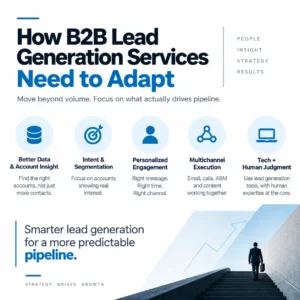
Modern B2B Lead Generation Services need to move beyond contact databases and outreach volume. A stronger approach combines:
- Accurate data and account intelligence: Identify the right accounts and understand relevant stakeholders, priorities, and business context.
- Intent signals and segmentation: Recognize meaningful research and engagement patterns to distinguish active interest from general awareness.
- Personalized engagement: Use buyer context to determine what to say, when to reach out, and which channel is most appropriate.
- A connected multichannel approach: Email can support personalized outreach, telemarketing can validate needs through direct conversations, ABM can focus on high-value accounts, and content can support buyers who are still researching.
- Integrated execution: These activities should work from a shared understanding of the account rather than operate as disconnected campaigns.
- Technology with human judgment: B2B Lead Generation Tools can support research, enrichment, scoring, and engagement, but data quality, messaging, segmentation, and human judgment ultimately determine the outcome.
AI adoption is also extending into the teams responsible for generating and qualifying demand. 60% of BDRs were using AI tools, according to 6sense’s 2025 BDR Benchmark report. This points to a broader shift in how lead generation teams research accounts, identify signals, and prepare for outreach.
These capabilities can become an important part of modern b2b lead generation strategies when applied to real buyer and account data, helping teams improve research, targeting, and outreach without replacing human judgment.
What Buyers Should Expect From a Modern B2B Lead Generation Company
As AI changes how buyers research vendors, expectations from lead generation providers are changing too.
A modern B2B Lead Generation Company should be able to answer more than who the prospect is. It should help determine:
- Is this the right account?
- Which stakeholders are relevant?
- What business problem may be driving the research?
- What signals suggest meaningful interest?
- Where might the account be in its buying journey?
- What has the prospect already engaged with?
- Is now the right time for outreach?
- What should the conversation focus on?
This is where an integrated approach becomes valuable.
The objective is not simply to generate more leads. It is to improve who gets targeted, why they are targeted, when outreach happens, and what the resulting conversation is about.
Conclusion
AI-powered search is not eliminating B2B lead generation. It is changing what happens before a lead reaches sales. Buyers can now research vendors, compare solutions, explore recommendations, and build shortlists before engaging with a provider. By the time they speak with sales, much of their early evaluation may already be complete.
For a B2B Lead Generation Company, this raises the standard. Effective lead generation now requires stronger buyer intelligence, relevant intent signals, precise targeting, and outreach that reflects what buyers are trying to solve. The companies that adapt will be better positioned to engage informed buyers.
Almoh Media helps B2B businesses turn buyer intelligence into relevant targeting, engagement, and lead generation. Connect with Almoh Media to build a strategy aligned with how buyers research and make decisions today.
FAQs
1. How is AI search changing the role of a B2B Lead Generation Company?
AI search is helping buyers research vendors, compare solutions, and evaluate providers before speaking with sales. A B2B Lead Generation Company must therefore use stronger buyer intelligence, intent signals, and account insights to make outreach more relevant.
2. What should businesses expect from B2B Lead Generation Services in the AI search era?
Businesses should expect B2B Lead Generation Services to go beyond contact acquisition and outreach volume. They should combine accurate data, intent signals, account intelligence, personalization, and multichannel engagement to reach informed buyers at the right time.
3. How can AI improve the lead generation process?
AI can help strengthen the lead generation process by supporting account research, identifying relevant buying signals, enriching prospect data, and helping teams prioritize accounts. Human judgment remains important for validating intent and deciding when and how to engage.
4. Which B2B Lead Generation Tools can support AI-driven buyer research?
B2B Lead Generation Tools can support prospect research, data enrichment, intent analysis, segmentation, lead scoring, and personalized outreach. The most effective tools complement reliable data and human decision-making rather than replacing them.
5. How should companies adapt their b2b lead generation strategies to AI search?
Companies should build b2b lead generation strategies around buyer questions, account context, intent signals, relevant content, and personalized outreach. Since buyers may already have a shortlist before contacting sales, teams need to understand what prospects know and what they are trying to solve.
Introduction
If you’re using content syndication, chances are you see it as just another way to get your content in front of more eyes. That’s fine, but there’s a lot more hidden beneath the surface. When you allow its full potential, content syndication ROI can surprise you, and it doesn’t take much to shift perception.
Let’s look at fresh data, outline a winning content syndication strategy, and show how U.S. B2B teams can get real value from it. Let’s begin!
What Is Content Syndication?
At its simplest, content syndication means sharing your B2B content: whitepapers, case studies, blogs on someone else’s site or network. This can be paid or free. You expand your reach, tap into new networks, and generate visibility, often reaching audiences you’d otherwise miss.
Why ROI From Content Syndication Deserves a Second Look
1. Huge lead production for relatively low spend
According to recent studies, the average cost per lead with content syndication is around $43. That’s far lower than other tactics, so even moderate conversion rates can offer solid returns.
2. Fast pipeline growth
Some platforms report that customers see 300–500% return on investment within three years. That’s not fluff – it’s real pipeline growth.
3. Verified conversion tracking methods
With UTM tagging and targeted vendor reports, U.S. marketers can track everything from initial syndication click to closed deal.
4. Built-in trust and positioning
Syndicating through known sites can give you indirect credibility, boosting brand awareness and authority without extra effort.
B2B Content Syndication Strategy: How to Do It Right
A good content syndication strategy starts long before content hits a third-party platform:
a). Pick assets that matter
Whitepapers, case studies, and long-form guides work best. They not only attract interest but also help establish your brand as industry-relevant.
b). Target lead quality, not rush volume
Instead of chasing clicks, target professionals. For example, top B2B firms average a 5.31% conversion rate on syndication offers.
c). Tag everything with UTM links
Measure traffic, engagement, bounce rates, and conversions back at your URL. This helps with syndication attribution.
d). Track core metrics
- CPL (cost per lead)
- MQL-to-SQL conversion rates
- Revenue per lead (use your average contract value)
e). Use the ROI formula
ROI= Revenue−Spend
Spend
For example, $1,000 spent → 50 high-quality leads → $5,000 average value = ($250k – $1k)/$1k = 249× ROI.
f). Optimize, rinse, repeat
Check what works by audience, site, and format. Then double down and drop what doesn’t.
Concrete U.S. ROI Stats You Can’t Ignore
| Metric | Statistics/Insight |
| Cost per lead | $43 average CPL |
| Syndication conversion rate | ~5.31% typical |
| Lead-to-deal conversion lift | 45% increase when focus is on quality |
| ROI over 3 years | 300%–500% reported |
| Projected industry growth | From $4.7 B in 2022 to $5.9 B by 2030 |
Content Syndication for Lead Gen: A Step‑by‑Step Plan
1. Define your ideal audience
Use buyer personas: titles, sectors, company size – so your content finds the right hands. This way, a sharper audience focus helps eliminate wasted spend and improves downstream lead quality.
2. Pick content with substance
Original research, how-to guides, competitive whitepapers – these both educate and convert. Plus, assets that solve specific problems tend to drive stronger engagement and more intent-driven leads.
3. Choose partners wisely
Use third-party platforms to reach U.S. B2B audiences. Look for those offering clear lead reporting and media kits. Before moving forward, ask for case studies or past performance metrics to make a more informed decision.
4. Structure campaigns with UTM tags
Make distinct tracking links for each partner and asset. This makes sure it’s easier to attribute leads, identify top performers, and compare ROI across channels.
5. Launch and monitor
Track CPL, CPL-to-SQL, cost per opportunity, pipeline driven, and revenue tied. At the same time, monitor activity in real-time to catch early trends and shift strategy fast if needed.
6. Review and refine monthly
Use metrics to shift spend toward top performers and tweak underperformers. As a result, consistent optimization keeps your syndication efforts aligned with revenue goals, not just vanity metrics.
How to Calculate Content Syndication ROI
- Calculate total spend (vendor fees + internal costs).
- Count total leads.
- Multiply leads by average deal size for potential revenue.
- Apply the ROI formula:
Revenue−Spend
Spend - Compare ROI over time to benchmark your initiatives.
This method is backed by multiple calculators and case studies.
Hidden Content Syndication Benefits
- SEO gains: Backlinks from quality sources can raise domain authority.
- Brand authority: Recognition on respected sites = credibility.
- Extended content life: A blog post can live on for months if syndicated well.
- Nurture acceleration: Leads from syndication are often further along in buying cycles.
Mistakes to Avoid and Fix Fast
Mistake: Only tracking clicks, not deals.
Fix: Tie every lead back to conversions with CRM integration. That way, you get a clearer picture of what’s actually driving revenue, not just traffic.
Mistake: Focusing only on cheap volume.
Fix: Go after quality; MQL-to-SQL rates matter most. Otherwise, your sales team will waste time on leads that won’t convert.
Mistake: Publishing irrelevant content.
Fix: Audit content – ensure tone, relevancy, and depth match syndication partner audiences. In doing so, you increase the chances of your content resonating with the right decision-makers.
Mistake: Not optimizing over time.
Fix: Regular performance review. Cut poor performers, boost winners. Over time, this helps improve ROI and keeps your content syndication strategy focused and results-driven.
Why Lead Quality Beats Volume
Not all leads are created equal. A smaller batch of high-intent leads can drive more revenue than a huge pool of low-interest ones.
Many B2B brands in the USA are shifting toward account- based syndication, where campaigns are matched to specific industries or companies. This helps improve conversion rates, shorten sales cycles, and increase customer lifetime value.
In short, prioritizing lead quality helps improve the long-term content syndication ROI, especially when targeting high-ticket accounts.
How AI Is Shaping the Future of Syndication
AI tools are starting to reshape content syndication strategy by analyzing behavior patterns and automating placements across high-performing channels.
With predictive scoring, marketers can now:
- Match content formats to individual user segments
- Forecast lead readiness using engagement scores
- Automate syndication at scale using content intent data
These innovations are raising the ceiling on what’s possible for B2B content syndication, especially for companies focused on measurable results.
About Almoh Media
Use metrics to shift spend toward top performers and tweak underperformers.
As a result, consistent optimization keeps your syndication efforts aligned with revenue goals, not just vanity metrics.
At Almoh Media, we specialize in high-impact content syndication for lead gen. We help B2B companies in the U.S. grow their pipelines by delivering:
- Verified lead generation from trusted channels
- Industry-specific targeting and campaign setup
- Transparent reporting tied to your sales funnel
- A proven strategy backed by real ROI
We understand the U.S. B2B buyer journey, and our syndication campaigns are built to generate demand, not just clicks.
Final Takeaway
Content syndication is an easy win if done smartly.
Focus on:
- Quality, not just volume
- Clear tracking and attribution
- Lead-to-deal conversions
- Continuous optimization
With $43 CPL, 5+ percent conversion, and long-term returns of 300–500%, most U.S. B2B teams can justify putting more budget behind it.
Ready to Get Real ROI from Content Syndication?
Let Almoh Media help you build a smarter lead-gen machine. We bring strategy, scale, and precision to content syndication – so your campaigns don’t just get seen; they convert. Reach out now to get started.
-
 What Happens After the Download? Rethinking B2B Content Syndication Services
 -
 Your Prospect Opened the Email. Now What? The Next Step in B2B Email Marketing Services
 -
 Beyond Cold Calling: How B2B Telemarketing Services Are Changing
 -
 What Are the B2B Lead Generation Best Practices That Actually Drive Pipeline?
 -
 Why More B2B Teams Are Moving Toward Outsourced B2B Lead Generation

